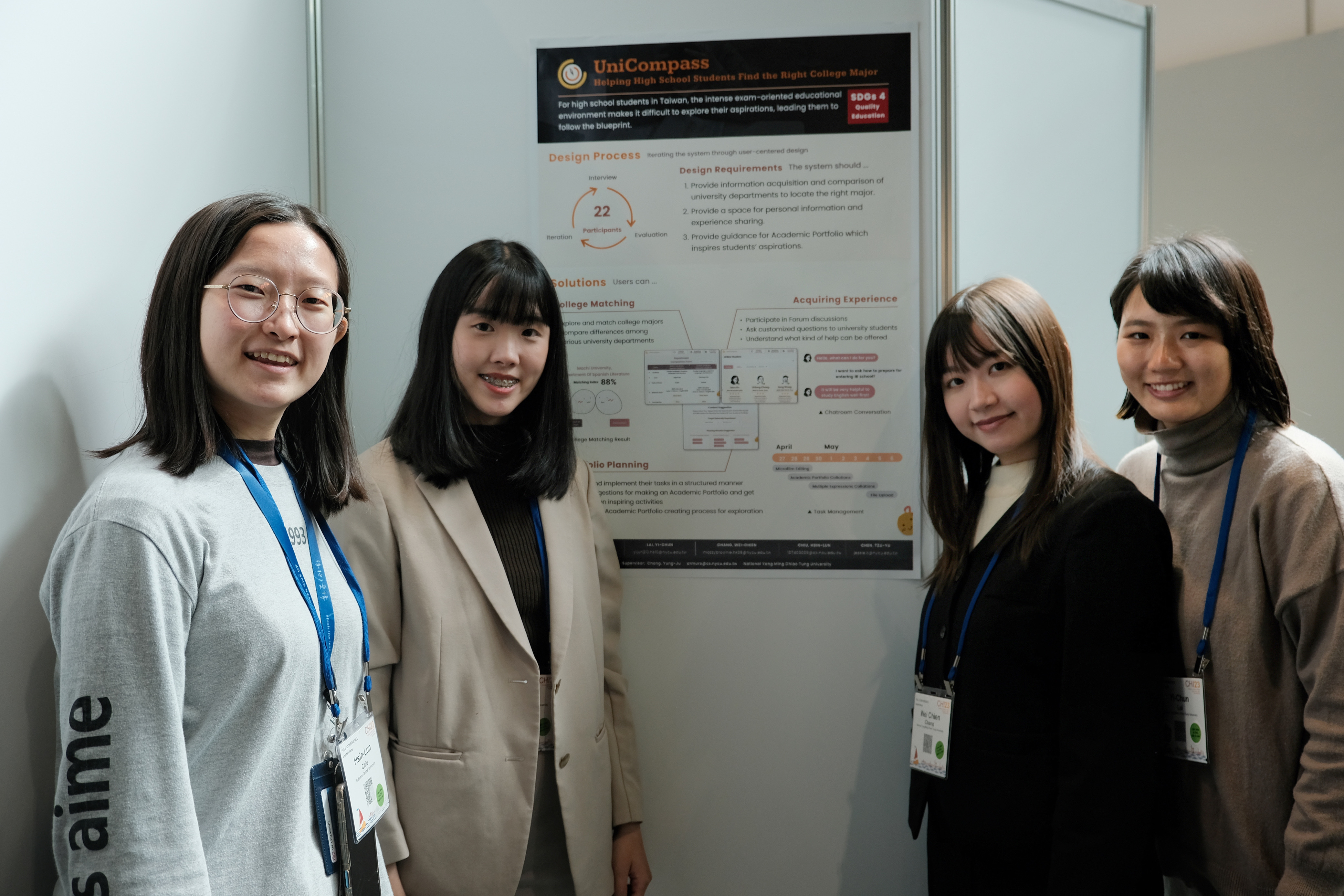


We began by studying the difficulties high school students face when considering their future career paths and college majors.
To gather information, we initially interviewed 7 university students. Our goal was for them to share their personal experiences, needs, and obstacles encountered during their own exploration of potential college majors that they were interested in and suitable for.
We used affinity diagramming(image below) to analyze the transcripts and identified several key themes. These results were then used to create personas and identify design requirements.

In developing the personas, we created a behavioral spectrum based on participants’ considerations for choosing universities and departments, methods of obtaining information, concerns and constraints.
Based on the results of the data analysis, we focused on the most critical aspects that cause difficulties for high school students in the process of choosing a college major.
The system should:
We performed sketching ideation based on the design requirements. We proposed several design concepts for each requirement, and for each design concept, we developed variations.
We created prototypes and obtained individual feedback to improve them in the next iteration and recruited a total of 11 participants to evaluate the prototype we created and obtain their feedback on the design concept, interaction flow, and usability.
Through this process, we also gained new insights that prompted us to revise our new design requirements.
The system should:
Users can…
Users can…
Users can…
We employed the think-aloud technique for the usability test and recruited 11 high school and university students to evaluate the platform.
Participants were asked to complete 6 tasks related to the main functions of the system, all of which were completed successfully, achieving a 100% success rate. Additionally, the system's overall usability, as measured by the SUS score, was 78.9, indicating that it is easy to use.
After the usability test, we also conducted interviews with the participants. They provided positive feedback on UniCompass, stating they would use it regularly, found it user-friendly and well-integrated, and that it helped them explore university departments. Participants also appreciated the ability to directly learn from current university students, as they found their information more valuable and useful than that provided by official school websites.
We wrote this project as a research paper and submitted it to CHI'23 Student Design Competition, where it ranked among the top 16 globally. We traveled to Hamburg, Germany to present our work.
This research is now published in the CHI EA '23 Proceeding and can be found in the ACM Digital Library.